

The Water Is Right There. But What Are Your Rights?
In Michigan, the shoreline of a natural inland lake is generally owned by the property owner whose land borders the water. That ownership usually includes riparian rights, which allow reasonable access to and use of the lake.
On many natural inland lakes, ownership interests also extend beneath the water toward the center of the lake.
The exact rights depend on the property's ownership documents, the type of lake, and Michigan law.
Who Owns the Shoreline?
There are several common ownership arrangements:
Private lakefront property: The adjoining property owner generally owns the shoreline and holds riparian rights.
Association-owned shoreline: A homeowners association or another entity owns the waterfront, with residents using it according to recorded rights and association rules.
Deeded lake access: A property owner has documented rights to reach or use the lake through another parcel.
Public shoreline: A government entity owns the waterfront and establishes rules for public access.
For an explanation of common waterfront terms, see Lake Home Basics: Learn the Language of Michigan Lakefront Real Estate.
What Are Bottomlands?
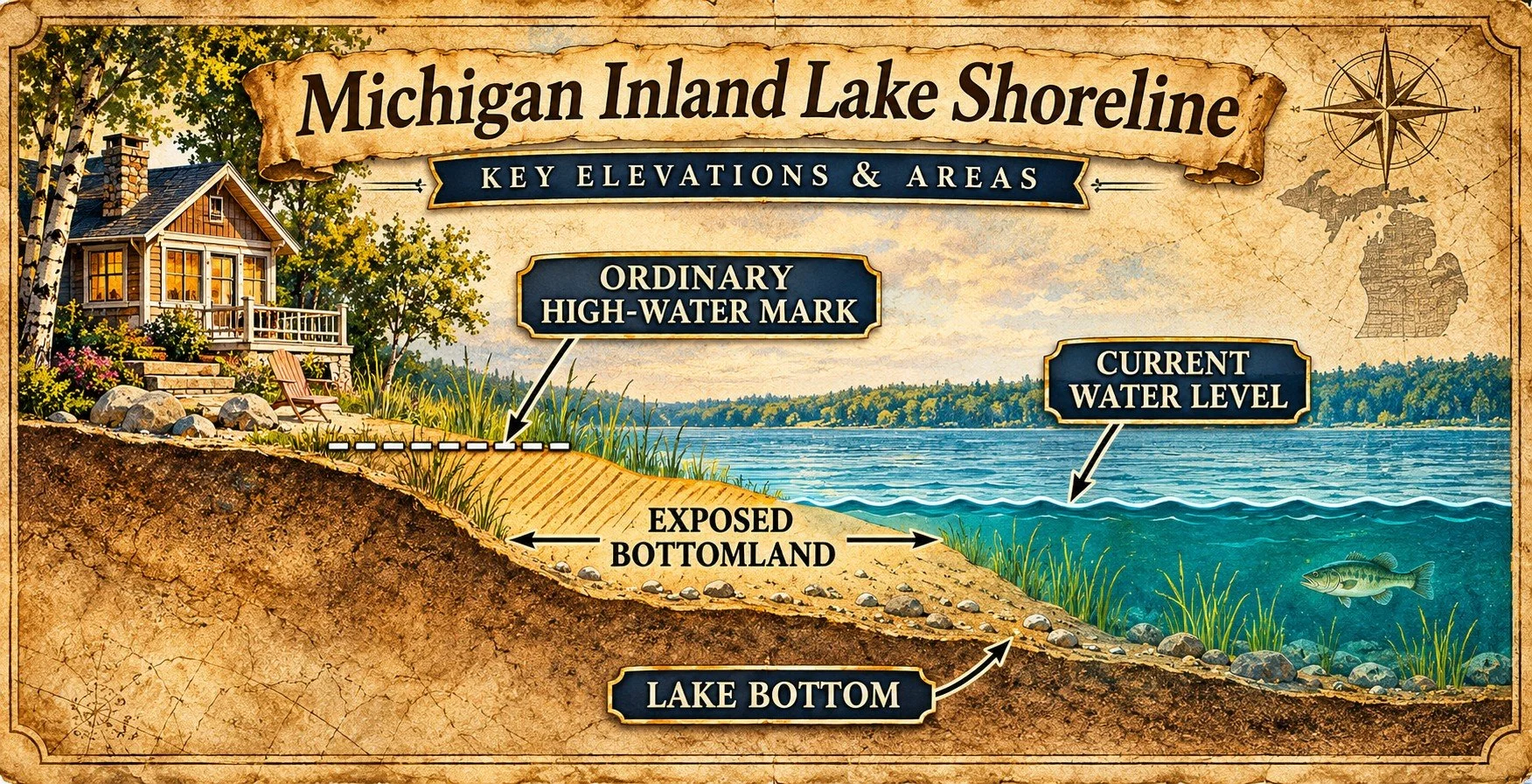
Michigan law defines bottomland as the area of an inland lake or stream below the ordinary high-water mark (OHWM). This includes land underwater and land temporarily exposed when water levels fall.
The ordinary high-water mark is identified using physical evidence of typical water levels, including changes in soil and vegetation.
On many natural inland lakes, adjoining waterfront owners hold ownership interests in the bottomlands.
Michigan calls the portion of a lake over which an owner has an ownership interest a riparian interest area.
These areas commonly extend toward the center of the lake. Their boundaries depend on the shoreline's shape and neighboring property arrangements.
Artificial lakes may have different ownership arrangements, including situations where the lake bottom is owned separately from the surrounding homes.
Source: Michigan Legislature — MCL 324.30101.
What Rights Come With Shoreline Ownership?
Michigan riparian rights generally include:
Access to the adjoining water.
Reasonable use of the water for swimming and other lawful activities.
Dockage to navigable water, subject to applicable restrictions.
Certain rights involving naturally accumulated shoreline land.
Protection of private property interests from unauthorized use.
These rights coexist with those of neighboring waterfront owners and the public's lawful use of navigable waters.
A waterfront owner may own a portion of the lake bottom while the water above it remains available for lawful boating and recreation.
Michigan law also addresses temporarily exposed bottomland. Under MCL 324.30111, riparian owners retain specified property rights over exposed bottomland, subject to public trust rights.
What About Shared Beaches and Lake Access?
Some Michigan homes reach the water through a shared beach, walkway, or recorded easement.
The deed, subdivision plat, easement, and association documents establish how that access may be used.
For example, an easement may provide walking access and swimming privileges. Dock placement, boat storage, and permanent mooring are separate uses governed by the recorded rights and applicable restrictions.
When evaluating lake-access property, review:
Who owns the waterfront parcel.
Which properties have access rights.
Whether docks and boat lifts are permitted.
Whether boats can be stored or moored.
Whether an association manages the access area.
A Michigan real estate attorney can interpret recorded documents when ownership or permitted uses are unclear.
Can You Install a Dock or Boat Lift?
Michigan's Department of Environment, Great Lakes, and Energy (EGLE) regulates docks and boat hoists on inland lakes.
Seasonal docks and boat hoists: Generally exempt from state permitting when used privately for noncommercial recreation, removed after boating season, and compliant with the state's conditions.
Permanent docks and boat hoists: Generally require an EGLE permit.
Public or commercial docks: Generally require permits.
Seasonal structures must avoid unreasonable interference with navigation, other water users, and water flow. Structures in wetlands may have additional requirements.
Property ownership, association rules, local ordinances, and neighboring riparian rights also affect placement.
For specific requirements, see EGLE's Docks, Boat Hoists, and Swim Rafts Guide.
Can You Change the Shoreline?
Many improvements along Michigan inland lakes are regulated under Part 301 of the Natural Resources and Environmental Protection Act.
Common projects include:
Seawalls: Construction and replacement projects may require EGLE permits.
Beach sand: Placing sand or fill in regulated areas below the ordinary high-water mark generally requires a permit, with limited exemptions.
Dredging: Excavation of regulated lake bottomlands requires a permit.
Shoreline grading and filling: Work affecting regulated bottomlands may require approval.
Erosion control: Natural shoreline treatments, including vegetation and stone, are encouraged by EGLE where appropriate.
EGLE recommends natural shoreline protection where practical because vertical seawalls can affect erosion patterns and aquatic habitat.
For project information, visit EGLE's Inland Lakes and Streams Program.
How Do You Verify Shoreline Ownership?
Start with the property's recorded documents.
Deed and legal description: Establish the land being conveyed and may identify waterfront ownership or access rights.
Title commitment: Identifies recorded matters affecting title, including certain easements and restrictions.
Subdivision plat: May show dedicated access areas, waterfront lots, and other recorded features.
Property survey: Helps establish upland boundaries, shoreline frontage, and the location of improvements. Underwater riparian boundaries may require specialized surveying and legal analysis.
Association documents: Explain ownership, maintenance responsibilities, and permitted uses of shared waterfront areas.
County GIS parcel maps are useful for initial research but are not legal boundary surveys.
For more information, see Property Survey Basics: Boundaries, Corners, and Easements.
What About the Great Lakes?
Michigan's Great Lakes have different bottomland ownership rules.
The State of Michigan generally holds Great Lakes bottomlands in public trust. Public rights along Great Lakes shorelines also differ from those associated with inland lakes.
This article focuses primarily on Michigan's natural inland lakes.
Michigan Lakefront Resources
Michigan Legislature — Inland Lake Definitions (MCL 324.30101) — Definitions of bottomland, riparian interest areas, and ordinary high-water mark.
Michigan Legislature — Riparian Owner Rights (MCL 324.30111) — Rights involving waterfront ownership and temporarily exposed bottomland.
EGLE — Protecting Michigan's Inland Lakes (PDF) — Information about lake ownership, bottomlands, and environmental protection.
EGLE — Docks, Boat Hoists, and Swim Rafts (PDF) — State permit requirements and seasonal exemptions.
EGLE — Inland Lakes and Streams — Shoreline work, dredging, filling, and permit requirements.
Before Buying a Michigan Lake Home
Confirm who owns the shoreline, where the property's ownership interests extend, and which waterfront uses are permitted.
The deed, survey, title documents, and recorded access agreements provide the foundation for understanding the property.
For help buying or selling lakefront real estate in Southeast Michigan, visit SoldByCaleb.com.