
Lake Home Basics: Learn the Language of Michigan Lakefront Real Estate
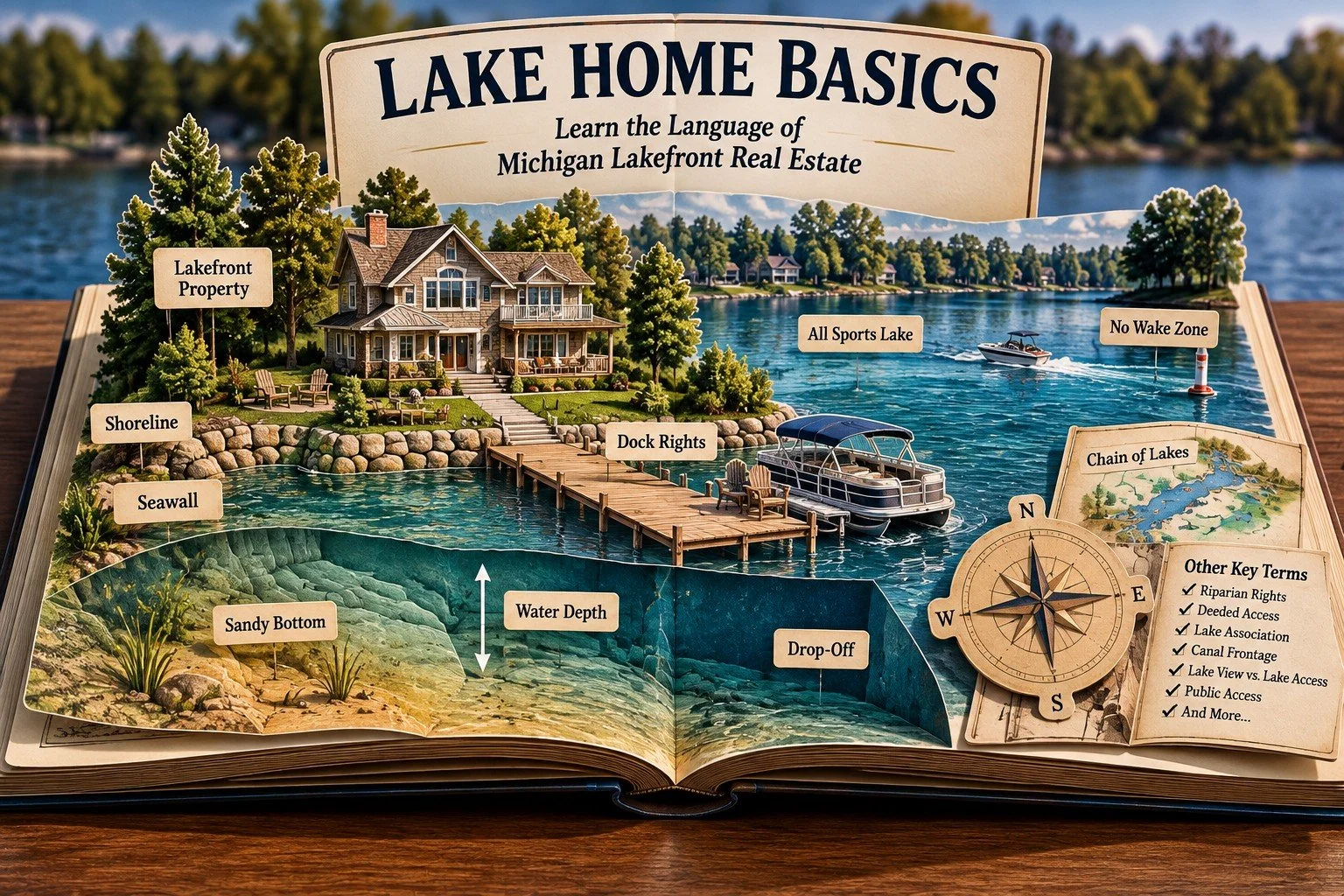
Shopping for a lakefront home in Michigan comes with its own vocabulary. You'll hear terms like all sports lake, deeded lake access, riparian rights, sandy bottom and lake frontage.
Understanding these terms can make a big difference when comparing properties. Two homes may both advertise lake access, yet offer very different ownership rights, recreational opportunities and waterfront experiences.
Here's a straightforward guide to help you speak the language of Michigan lakefront real estate.
1. Types of Lakes and Lake Properties
All Sports Lake: A commonly used real estate term for a lake that allows activities such as powerboating, tubing and water skiing, subject to applicable regulations.
No Wake Lake: A lake where boats must operate at slow no wake speed, meaning a speed that minimizes the wake created by the boat. Restrictions may apply to the entire lake or only certain areas.
Private Lake: Generally describes a lake without public access, but the term does not necessarily mean one person owns the lake or that every lakefront owner has unrestricted use.
Public Access Lake: A lake with an authorized public access point, which may include a boat launch or other designated access.
Chain of Lakes: Two or more lakes connected by navigable waterways. Boat size, water depth and bridge clearance may limit travel between them.
Inland Lake: A lake located inland rather than one of the Great Lakes. Michigan has thousands of inland lakes with different sizes, depths and recreational characteristics.
Lakefront Property: Property located directly along a lake shoreline.
Lake Access Property: Property with some form of permitted lake access, but not necessarily direct shoreline ownership.
Canal Frontage: Property bordering a canal or channel connected to a lake. Access to the main lake may depend on water depth, bridge clearance and legal rights.
2. Lake Ownership and Access Terms
Riparian Rights: Legal rights associated with ownership of land bordering water, potentially including reasonable water use, access and dockage, subject to Michigan law and applicable restrictions. Rights on inland lakes are often called riparian rights.
Deeded Lake Access: Lake access rights established through a recorded deed or other legal instrument. The exact rights depend on the document.
Shared Lake Access: An access area used by multiple property owners, sometimes through an association or recorded agreement.
Lake Easement: A legal right to use another person's land for a specified purpose, such as reaching the lake. An access easement does not automatically include the right to install a dock or keep a boat.
Lake Frontage: The length of a property's shoreline along the water, usually expressed in feet.
Bottomland Rights: Ownership or use rights involving the land beneath the water. These can affect docks and other waterfront uses.
Dock Rights: Rights to install or use a dock. They may depend on ownership, recorded agreements, association rules and government regulations.
Backlot Property: A property near a lake but not directly on the shoreline. It may or may not include lake access rights.
3. Water and Shoreline Terms
Sandy Bottom: A lakebed with predominantly sand, often desirable for swimming and wading.
Mucky Bottom: A lakebed with soft organic sediment that may make swimming or walking in shallow water less appealing.
Water Depth: The depth of the water at a particular location. Depth near a dock can matter for boat access and swimming.
Drop-Off: An area where the lakebed becomes deeper relatively quickly.
Seawall: A constructed barrier along the shoreline intended to help stabilize the bank and manage erosion.
Natural Shoreline: A waterfront edge that retains natural vegetation, slopes or other features rather than relying entirely on a constructed wall.
Shoreline Erosion: The gradual loss of soil along the waterfront due to water movement, waves or other conditions.
Lake Level: The height of the lake's water surface, which may fluctuate seasonally or be affected by a legally established lake level.
Wetlands: Areas where water influences soil and vegetation. Wetlands can affect how land may be improved or developed.
4. Boating and Recreation Terms
Slow No Wake: A regulated operating speed intended to minimize a boat's wake. It is not necessarily a universal numerical speed limit.
No Wake Zone: A designated area where boats must operate at slow no wake speed.
High-Speed Boating: Boating above certain speeds, sometimes restricted by lake, location or time of day.
Public Boat Launch: A designated location where the public may launch watercraft, sometimes subject to fees, hours or other rules.
Navigable Channel: A waterway connecting bodies of water or different portions of a lake that may accommodate boats, depending on conditions.
Lake Association: An organization of lake residents or property owners that may coordinate lake management, activities or maintenance. Membership and authority vary.
Lake Improvement Assessment: A charge that may be levied to fund qualifying lake improvements, such as aquatic plant management or other authorized projects.
5. Lakefront Property and Real Estate Terms
Walkout Basement: A lower level with direct access to the outdoors, often found on lakefront lots that slope toward the water.
Lake View: A view of the lake from the home or property. A lake view does not necessarily include ownership or access rights.
Waterfront Setback: The required distance between certain improvements and the water or another regulated boundary, depending on local rules.
Flood Zone: An area identified as having a particular flood risk. Being on a lake does not automatically mean a property is in a high-risk flood zone.
Shoreline Permit: Government approval that may be required for certain shoreline, dredging, filling, dock or seawall projects.
Lakefront Comparable Sale: A recently sold property used to help evaluate value, ideally with similar lake characteristics, frontage, location and property features.
Why These Terms Matter
Lakefront terminology isn't always used consistently from one community to another.
For example:
One lake may allow high-speed boating throughout most of its waters, while another limits it to certain hours.
Two properties advertised with lake access may have very different legal rights.
One home may have 100 feet of sandy, usable shoreline, while another has 100 feet of steep or heavily vegetated frontage.
A lake association may be voluntary in one community and have mandatory membership or assessments in another.
A property with a beautiful lake view may have no legal right to use the water.
The key is to understand what the listing describes and verify the details that matter to you.
Helpful Michigan Lakefront Resources
Michigan DNR Local Watercraft Controls: Check lake-specific boating regulations by county.
Michigan DNR Inland Lake Maps: Explore available lake maps and depth information.
Michigan EGLE: Research environmental regulations and waterfront permitting.
FEMA Flood Map Service Center: Check mapped flood hazards for a property.
The Bottom Line
Buying a Michigan lake home is about more than choosing a house with a great view. Understanding lake terminology helps you compare properties, recognize differences in access and recreation, and ask more informed questions.
Whether you're considering an all sports lake in Oakland County, a quiet lake in Livingston County or waterfront property elsewhere in Southeast Michigan, learning the language is a great place to start.
For help buying or selling Michigan lakefront real estate, visit SoldByCaleb.com.