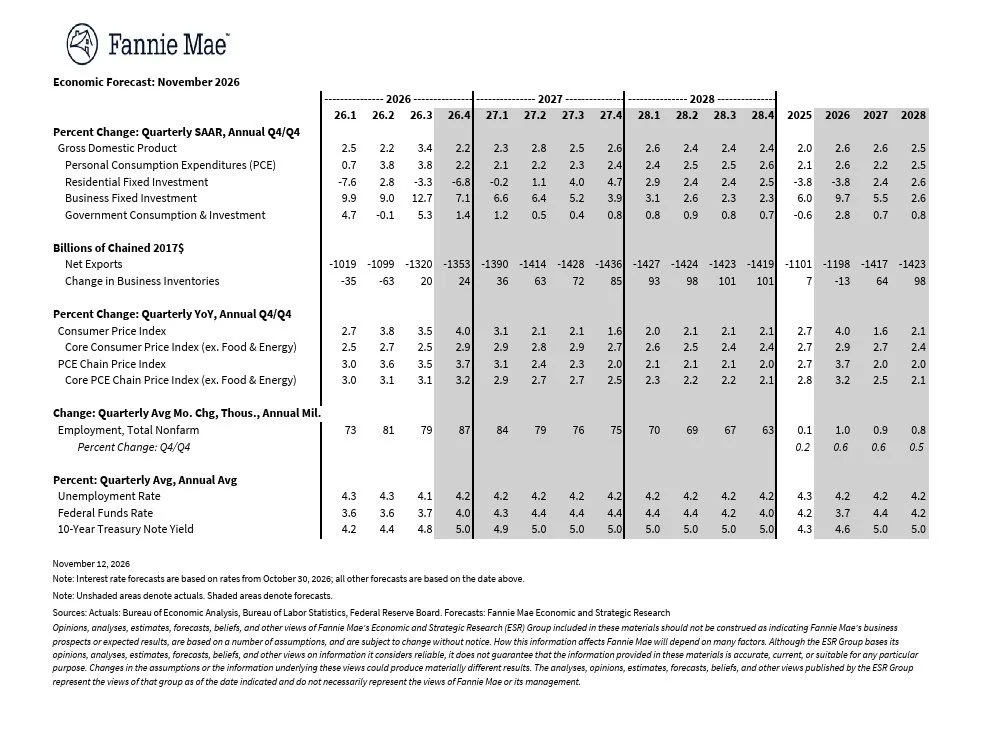
Fannie Mae released its November 2026 economic forecast, offering a look at where the economy, inflation, interest rates, and housing activity may be headed over the next two years.
The overall picture? The economy is expected to keep growing, but borrowing money may remain expensive.
Here's what matters for Michigan homebuyers and sellers.
1. Mortgage Rates May Stay Higher for Longer
One of the most interesting predictions involves the 10-year Treasury yield.
This is an interest rate on government bonds that often influences mortgage rates.
Fannie Mae predicts:
2026: 4.6%
2027: 5.0%
2028: 5.0%
These are Treasury yields, not mortgage rates.
Mortgage rates are generally higher than Treasury yields and can move for several reasons.
What this means: Buyers hoping for a major drop in mortgage rates may need to be patient. The forecast suggests borrowing costs could remain challenging.
2. Inflation Is Expected to Slow
Inflation measures how quickly prices are increasing.
Fannie Mae predicts:
2026: 4.0%
2027: 1.6%
2028: 2.1%
That's encouraging, but lower inflation doesn't mean prices are going back to where they were.
It means prices are expected to rise more slowly.
For homeowners, that could mean some relief from rapidly increasing everyday expenses.
3. Housing Activity Could Improve in 2027
Fannie Mae expects residential investment, which includes home construction and improvements, to change by:
2026: −3.8%
2027: +2.4%
2028: +2.6%
After a difficult 2026, spending on housing construction and improvements is expected to begin recovering in 2027.
This could be encouraging for builders, contractors, and the housing industry.
However, these figures are not predictions of home prices or the number of homes sold.
4. The Economy Is Expected to Keep Growing
Fannie Mae predicts economic growth of approximately:
2026: 2.6%
2027: 2.6%
2028: 2.5%
Unemployment is also expected to remain around 4.2%.
In simple terms, Fannie Mae expects continued economic growth without a major increase in unemployment.
A steady economy can help support housing demand, although local market conditions still matter.
What Does This Mean for Michigan Buyers and Sellers?
For buyers: Plan around today's mortgage rates and a monthly payment you can comfortably afford. Lower rates in the future would be helpful, but they aren't guaranteed.
For sellers: Home prices will continue to depend heavily on local competition, property condition, and buyer demand. A national economic forecast is only part of the picture.
For homeowners: Construction and renovation activity may improve in 2027, but the value of improvements still depends on the property and local market.
Final Thoughts
Fannie Mae's forecast points toward a growing economy, slower inflation, and improving housing investment.
The biggest challenge for real estate may continue to be the cost of borrowing money.
For Michigan buyers and sellers, the best decisions will still come from understanding the local market, current financing options, and your individual goals.
These numbers are forecasts, not guarantees. Economic conditions can change.