
Whole-House Generator Basics
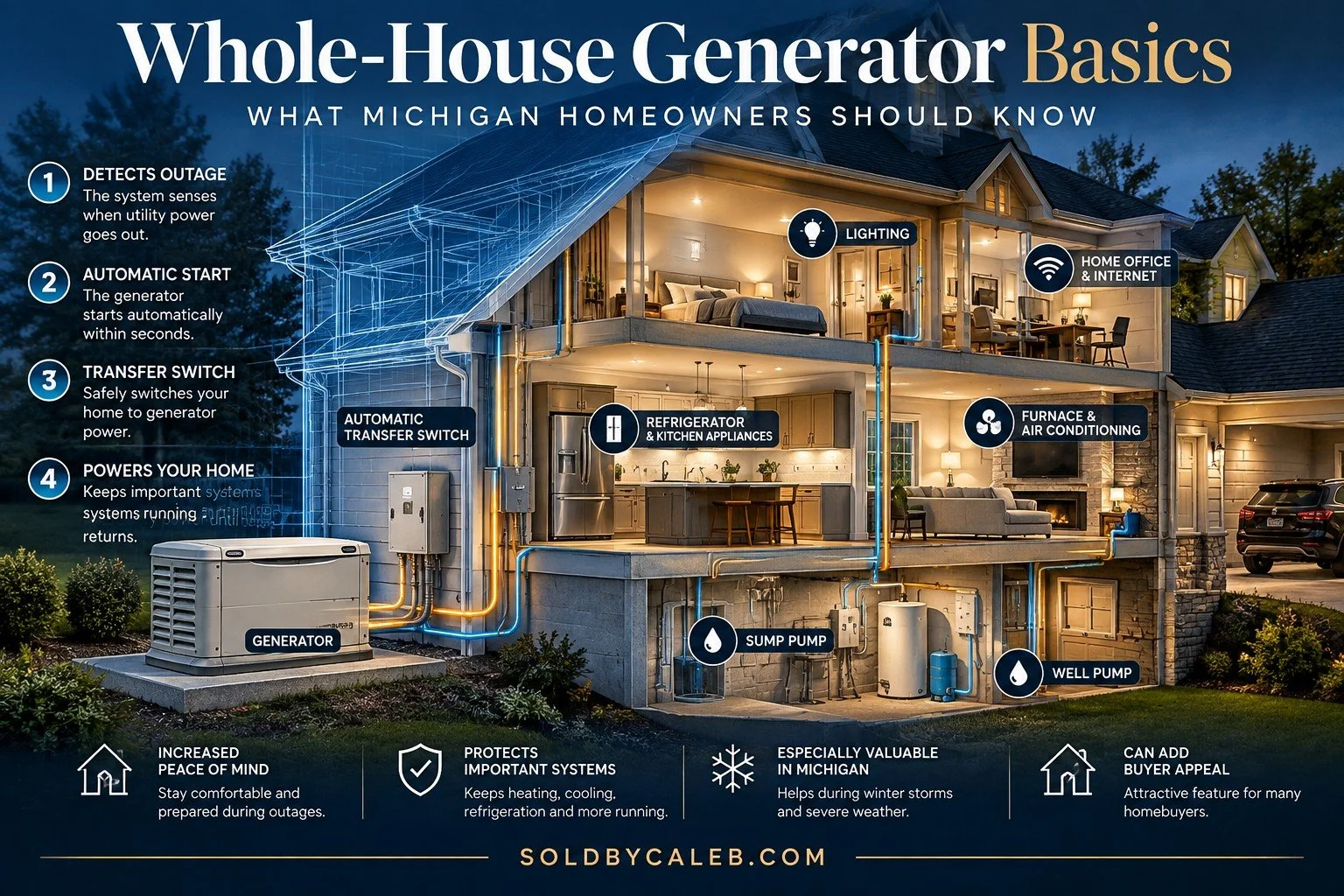
Imagine a winter storm knocks out power to your neighborhood. The lights go out, the furnace stops running, and you're wondering how long the outage will last.
Now imagine a few seconds later, a generator starts outside, the lights come back on, and much of your home continues operating.
That's the appeal of a whole-house generator.
Whether you're considering installing one or buying a home that already has one, here's what Michigan homeowners should understand.
What Is a Whole-House Generator?
A whole-house generator, also called a home standby generator, is a permanently installed system designed to provide electricity when utility power is interrupted.
Unlike a portable generator, a standby system is typically connected directly to the home's electrical system and a dedicated fuel supply.
Most residential systems include three main components:
Generator: Produces electricity when utility power is unavailable.
Automatic transfer switch: Safely switches the home's electrical supply between the utility and generator.
Fuel supply: Usually natural gas or propane.
The generator is installed outdoors, usually near the house, with placement determined by manufacturer instructions and applicable codes.
How Does a Standby Generator Work?
One of the biggest advantages of a standby generator is that it can operate automatically, even when nobody is home.
Here's the basic sequence:
Utility power goes out.
The system detects the outage.
The generator starts automatically.
The automatic transfer switch connects the designated electrical loads to generator power.
When utility power returns and stabilizes, the system switches back.
The generator completes its shutdown cycle.
This process generally takes several seconds or longer, depending on the system. It isn't the same as an uninterrupted power supply.
The automatic transfer switch is especially important because it prevents generator electricity from being sent back into utility lines during an outage.
What Can a Whole-House Generator Power?
The answer depends on the generator's capacity, the home's electrical demands and how the system was installed.
Depending on the setup, a generator may power:
Refrigerators and freezers
Furnace blowers or boilers
Central air conditioning
Sump pumps
Well pumps
Lighting and outlets
Internet equipment and home offices
Certain kitchen and laundry appliances
Here's an important distinction: A whole-house generator doesn't necessarily mean every appliance can operate simultaneously.
Some systems are designed to power the entire home's normal electrical distribution, while others serve only selected circuits.
Larger electrical loads, such as air conditioning, electric heating, water heaters and EV chargers, may require additional generator capacity or automatic load management.
If you're buying a home with a generator, ask which circuits and appliances are actually supported.
Generator Size and Fuel Source
Residential standby generators are commonly available in capacities ranging from roughly 10 to 26 kilowatts, with larger options available.
But choosing the right size isn't as simple as looking at the home's square footage.
An electrician or qualified generator installer should evaluate:
Electrical service and connected loads
Heating and cooling equipment
Motor starting requirements
Well and sump pumps
Electric appliances and EV charging
Whether certain loads can be managed automatically
Natural Gas vs. Propane
Natural gas is convenient when the home has an available utility connection. It eliminates the need for an on-site fuel tank, although supply and pressure requirements must be verified.
Propane is common for rural properties without natural gas service. It requires a properly sized storage tank, and available runtime depends on fuel consumption and the amount of propane remaining.
Both types require proper installation, ventilation and regular maintenance.
What Does a Whole-House Generator Cost?
A professionally installed standby generator is a significant home improvement.
For preliminary budgeting, many residential installations fall somewhere around $7,000 to $15,000 or more, although complex installations and larger homes can exceed that range. This is a general planning estimate, not a Michigan contractor quote.
The total cost can include:
Generator equipment
Automatic transfer switch
Electrical wiring and panel modifications
Natural gas piping or propane connections
Concrete or approved mounting pad
Permits and inspections
Labor and startup testing
A larger home doesn't automatically need the largest available generator. Proper sizing and thoughtful load management may provide a more economical solution.
Before purchasing, obtain an itemized estimate that identifies exactly what will be powered.
Buying a Home That Already Has a Generator?
A standby generator can be an attractive feature when shopping for a home, but don't assume that its presence means the system is working properly.
Questions worth asking during the buying process:
What is the generator's manufacturer, model and age?
How many kilowatts can it produce?
Is it powered by natural gas or propane?
Which parts of the house receive backup power?
Are service records available?
Has it operated successfully during recent outages?
Does the automatic transfer switch function properly?
Were required installation permits obtained?
Is any manufacturer warranty still in effect, and is it transferable?
Can a qualified technician demonstrate and evaluate the system?
A generator is another major mechanical component worth understanding before purchasing.
For a broader look at evaluating a home's systems, read What Should You Inspect Before Buying an Older Michigan Home?.
Does a Whole-House Generator Add Property Value?
A standby generator may increase a home's appeal, particularly for buyers who value reliability and convenience.
It can be especially attractive in homes with:
Sump pumps or private wells
Home offices
Extensive refrigeration or freezer storage
Important electrical equipment
Larger homes with multiple mechanical systems
However, buyer appeal and appraised value aren't necessarily the same thing.
A generator doesn't guarantee that a homeowner will recover its full installation cost when selling. Its age, condition, capacity, installation quality and local buyer demand can all influence how the feature is perceived.
Is a Whole-House Generator Worth It?
For some Michigan homeowners, the convenience and peace of mind make a standby generator a worthwhile investment. For others, a smaller backup system may be sufficient.
The right decision depends on your home's electrical needs, how important continuous power is to your household and the cost of installation and maintenance.