
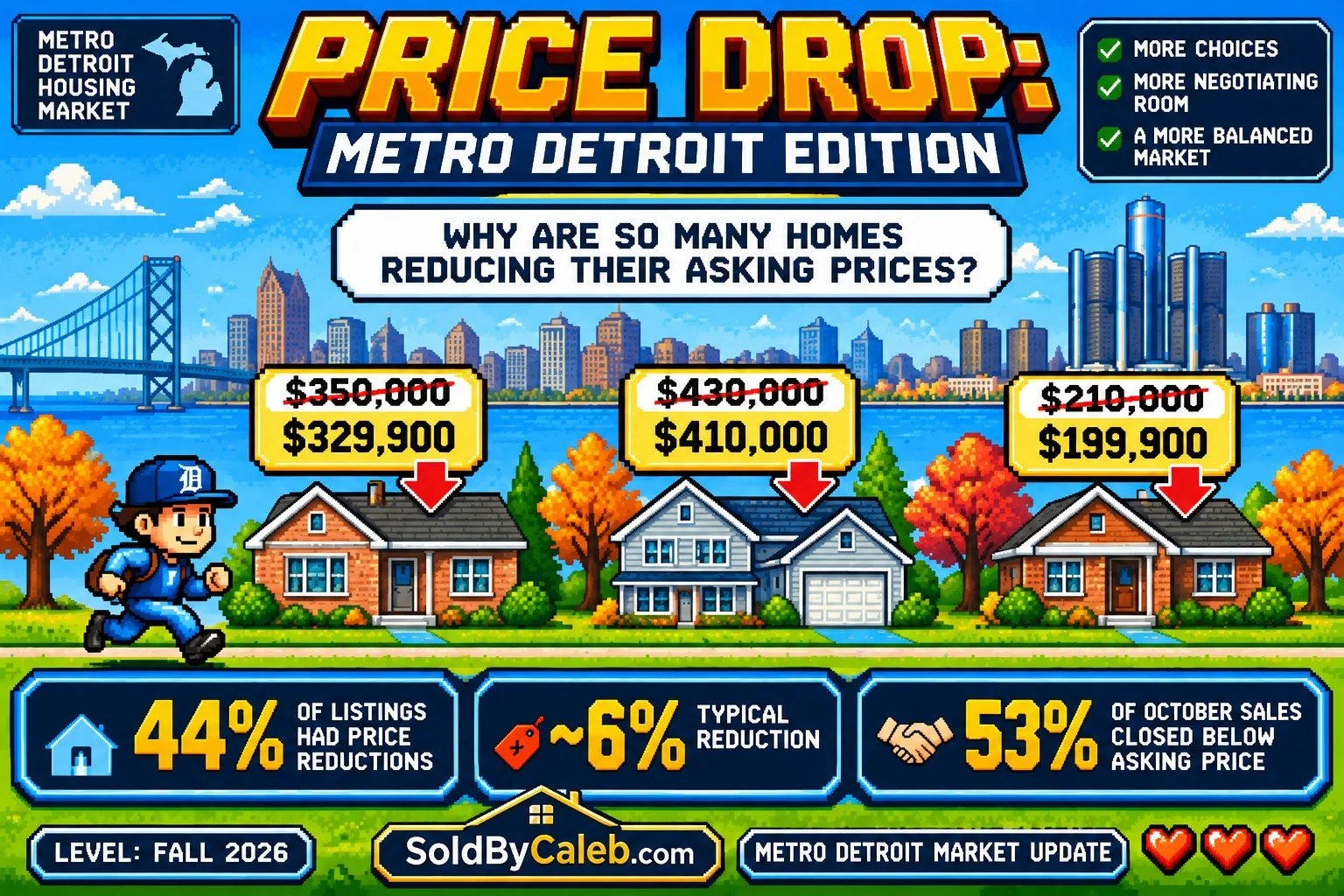
If you've been looking at homes around Metro Detroit lately, you may have noticed something that was less common a few years ago: price reductions.
A home gets listed for $350,000. A few weeks later, it's $339,900. Another seller lowers the asking price by $15,000. Buyers who once had to make quick decisions are finding more opportunities to compare homes and negotiate.
And now we have some numbers to back that up.
Nearly 44% of Listings Have Had Price Reductions
According to a November 18, 2026, Detroit Free Press report, approximately 44% of homes on the market in Wayne, Oakland, and Macomb counties had undergone asking-price reductions.
The typical reduction was around 6%, based on an analysis of Realcomp MLS data conducted by Real Estate One's research team.
The same report found that 53% of homes sold during October closed below their final asking prices, compared with 48% one year earlier.
These numbers tell us something important about the market: more sellers are adjusting their expectations, and buyers are having greater success negotiating.
But there's a difference between a home reducing its asking price and the overall housing market losing value.
A Price Reduction Isn't the Same as Falling Home Values
Let's use a simple example.
A seller lists a house for $350,000, hoping to attract a buyer at that price. After several weeks without an acceptable offer, the seller reduces the asking price to $329,900.
That's a reduction of $20,100, or about 5.7%.
But what if comparable homes in the neighborhood have been selling for around $330,000 all along?
The seller may simply be bringing the asking price closer to what the market supports.
A price reduction tells us what happened to the asking price. A comparable sale tells us what a buyer actually paid.
This distinction matters because a large percentage of listings with price reductions can exist alongside stable or even rising year-over-year home prices.
What Do the Actual Sales Numbers Show?
The October 2026 Realcomp Housing Market Report provides a broader picture of Southeast Michigan's housing market.
Across the full Realcomp MLS reporting area:
8,610 homes sold in October 2026, down 16.8% from October 2025.
30,851 homes were on the market, up 17.9% from a year earlier.
The median sales price was $283,000, up 2.9% year over year.
Average days on market reached 40, compared with 38 a year earlier.
These figures cover a larger area than the three-county analysis in the Free Press article, so they shouldn't be treated as identical markets.
Together, though, the reports show a similar pattern: fewer completed sales, more available listings, and additional time for buyers to consider their options.
Why Are Sellers Reducing Their Prices?
Several factors can contribute to a price reduction.
The original asking price was too high. A seller may have started above recent comparable sales, hoping a buyer would pay a premium. If showings and offers don't support that price, an adjustment may be necessary.
Buyers are watching their monthly payments. Mortgage interest, property taxes, homeowners insurance, and maintenance all affect affordability. A house may be attractive, but buyers still have to make the numbers work.
There are more homes to choose from. When several similar properties are available, buyers can compare condition, updates, location, and price rather than focusing on one listing.
The season is changing. Michigan's housing market typically experiences seasonal changes in activity. Late fall and winter can bring fewer active buyers, although serious buyers and sellers remain in the market.
What Does This Mean for Homebuyers?
More price reductions can create opportunities, especially for buyers who have been frustrated by competition.
A buyer may have more time to schedule inspections, review comparable sales, evaluate repairs, and negotiate contract terms.
But the asking price is only one part of the deal.
For example, consider a home listed for $300,000 that has been reduced to $285,000. Before deciding whether it's a good opportunity, look at:
What similar homes have recently sold for
How long the property has been listed
Whether it has already had multiple price reductions
The home's condition and likely repair costs
Property taxes, insurance, and total monthly payment
Whether the seller is offering closing-cost concessions
Sometimes a seller may be more willing to contribute toward closing costs than reduce the price further. The best arrangement depends on the buyer's financing, available cash, and the property's value.
What Does This Mean for Home Sellers?
For sellers, the first few weeks on the market are important.
A new listing generally receives attention from buyers who have been watching for homes that match their search criteria. Starting with a price that reflects recent comparable sales helps make the most of that exposure.
If a property isn't attracting showings or offers, review the entire presentation before deciding what to change.
Consider the asking price, photographs, property condition, competing listings, and feedback from buyers who have toured the home.
A price reduction can be a useful marketing adjustment, but pricing accurately from the beginning may prevent unnecessary time on the market.
A Real Metro Detroit Example
The Detroit Free Press reported on a ranch home in Rochester Hills that originally entered the market at $430,000 in July.
After a $10,000 asking-price reduction, the property eventually sold on November 13 for $410,000.
That's $20,000 below the original asking price.
The example illustrates how an ambitious starting price can eventually give way to the amount a buyer is willing to pay.
The same report described a St. Clair Shores home that began at $210,000, was reduced to $199,900, and ultimately sold for $206,000 with $11,000 in seller concessions.
That second example is particularly interesting. The final sales price was higher than the reduced asking price, but the seller also contributed toward the buyer's costs.
Price, concessions, condition, and financing all help tell the complete story of a transaction.
Is Metro Detroit Becoming a Buyer's Market?
The latest numbers suggest buyers are gaining negotiating opportunities, but market conditions still vary significantly by location and price range.
A well-maintained home priced competitively in Plymouth, Canton, Livonia, Northville, or another desirable community may still attract strong interest. A similar home priced above comparable sales may sit longer.
Even within the same city, two neighborhoods or price ranges can behave differently.
For buyers and sellers, the most useful information comes from recent comparable sales and the current competition surrounding a particular property.
What These Changes Mean Going Forward
Metro Detroit's housing market is changing, and the latest price-reduction numbers are worth paying attention to.
For buyers, more listings and greater negotiating opportunities can make the home search more manageable.
For sellers, accurate pricing, good presentation, and an understanding of current competition are becoming increasingly important.
The important question isn't simply whether a house has reduced its asking price. It's whether the current price makes sense compared with the homes buyers can choose from today.
Sources and Further Reading
For more Michigan homebuying and selling information, explore the SoldByCaleb Real Estate Guides.