
How Do You Price a House When There's Nothing Else Like It?
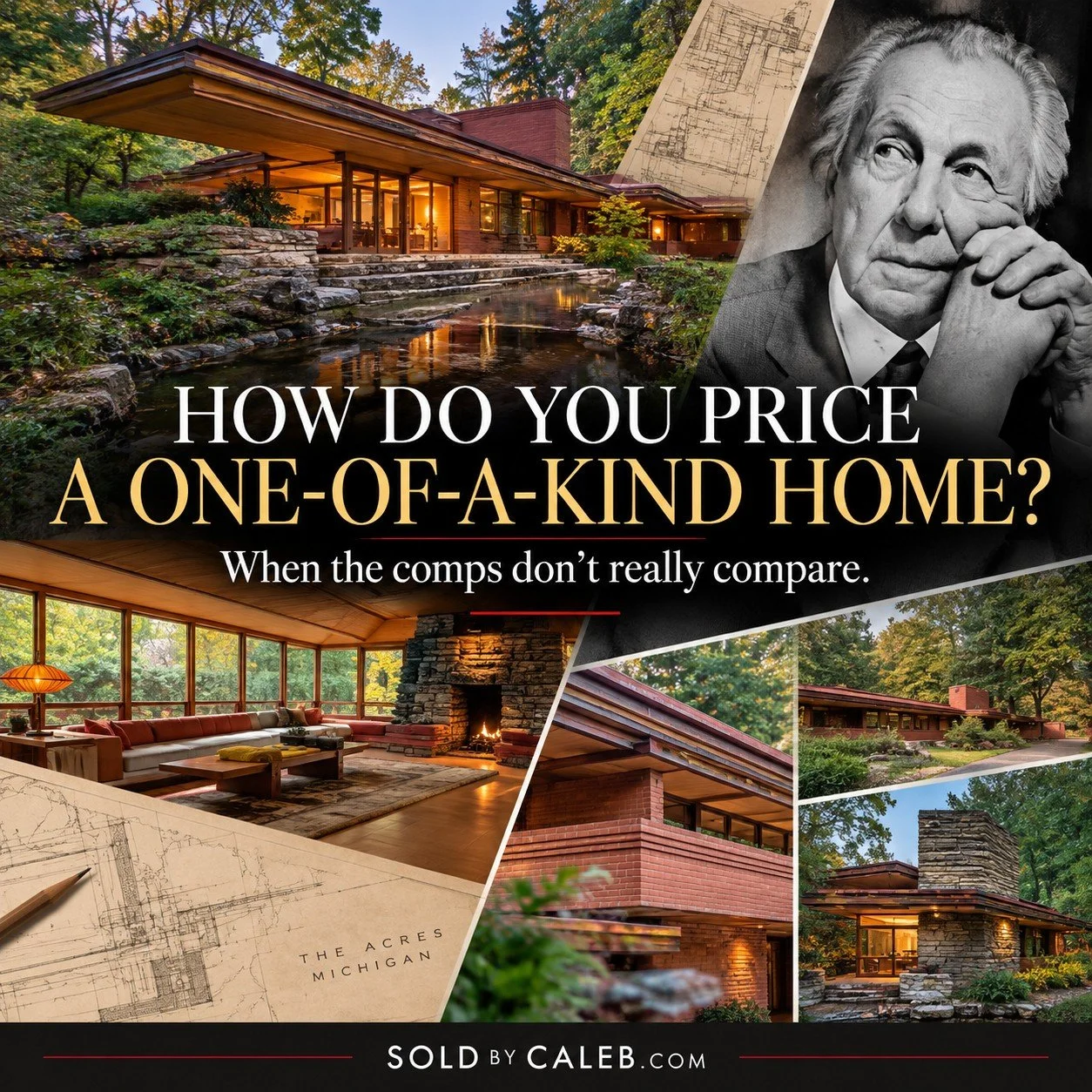
A Frank Lloyd Wright designed home in Michigan recently returned to the market for $2.1 million.
The Samuel and Dorothy Eppstein House, built in 1953 near Galesburg, Michigan, is part of The Acres, a small community designed by Wright. The three bedroom home sits on approximately two acres and is unlike almost anything else you'll find on the Michigan housing market.
Take a look at the current listing and photos of the Eppstein House. Once you see the architecture, the challenge of finding truly comparable sales becomes pretty obvious.
It raises one of the more interesting questions in real estate:
How do you determine the value of a house when there is almost nothing else like it?
Usually, We Start With Comparable Sales
When determining the potential market value of a typical home, recent comparable sales are one of the most important pieces of information.
Ideally, you want to compare properties with similarities such as:
Location
Square footage
Bedrooms and bathrooms
Architectural style
Age and condition
Lot size
Garage and additional buildings
Major improvements and renovations
This is the basic idea behind a Comparative Market Analysis. I explain that process in more detail in Before Listing Your Home, Look at Comparative Sales.
But real estate doesn't always cooperate.
There probably isn't another recently sold 1953 Frank Lloyd Wright house around the corner from the Eppstein House.
That's an extreme example, but the same problem happens throughout Michigan.
Some Homes Are Just Hard to Compare
Your house doesn't have to be famous to be unusual.
A property can become difficult to value when it has something that separates it significantly from the surrounding homes, such as:
Lakefront or unusual water frontage
Several acres surrounded by subdivisions
Custom architecture or construction
A major addition or extensive renovation
An oversized garage or workshop
An additional dwelling or outbuilding
Historic significance
An unusually large or private lot
A home substantially larger than others in the neighborhood
When that happens, finding three nearly identical sales nearby may simply be impossible.
What Happens When the Comps Don't Really Compare?
The search has to become more thoughtful.
You may need to look farther away, go further back in time or compare properties that aren't identical but share characteristics buyers are likely to value.
Then the differences have to be considered:
How much does additional acreage matter?
Is the location difficult to duplicate?
Does waterfront create genuine scarcity?
How does the construction quality compare?
Were renovations professionally completed?
Is an unusual feature something other buyers actually want?
What would it cost, or would it even be possible, to recreate the property?
This is where real estate valuation becomes less about simply finding three houses and more about understanding the market.
This House Has Another Twist
The Eppstein House isn't only being marketed as a residence.
According to the listing, the property has also operated as a short term rental, attracting people interested in experiencing a Frank Lloyd Wright designed home. The listing also describes the property being used for photo shoots, meetings and other purposes.
That adds another interesting layer to the valuation.
A potential buyer isn't necessarily evaluating only the bedrooms, bathrooms, acreage and architecture. The property's history and scarcity may also create opportunities that wouldn't exist with a typical house.
That doesn't automatically make the home worth a particular amount, but it demonstrates why unusual real estate can be so difficult to evaluate.
Unique Doesn't Automatically Mean Valuable
This is especially important for homeowners.
Something can be expensive without adding the same amount to the home's market value.
A homeowner might spend $100,000 adding a feature they absolutely love. That doesn't necessarily mean the property is now worth $100,000 more. The next buyer has to value that improvement too.
On the other hand, true scarcity can matter tremendously.
A great lakefront lot can't simply be recreated. Neither can acreage in a heavily developed community, certain architectural features, exceptional privacy or a location where properties rarely become available.
Why Automated Home Values Can Struggle With Unique Properties
Automated home value estimates rely heavily on property data and surrounding sales. They're useful as a starting point, but unusual properties can be especially difficult for an algorithm to evaluate.
A computer may recognize square footage, bedrooms, bathrooms and recent nearby sales. It may have a much harder time understanding why buyers would pay substantially more for a particular view, architecture, renovation quality, workshop, acreage or location.
I previously explained how these systems work in Automated Valuation Models.
The more unusual the property, the more important it becomes to understand what's actually driving buyer demand.
Pricing Still Has to Meet the Market
Even after all the analysis, there's one reality sellers can't escape.
The market ultimately decides what a property is worth.
You can study comparable sales, construction quality, replacement costs, location and unique features, but a buyer still has to agree that those differences justify the price.
That's why pricing an unusual home can require more strategy than pricing a typical house in a neighborhood with dozens of recent comparable sales.
If you're preparing to sell, Home Sellers, 5 Tips for a Successful Sale covers some of the other factors that can affect how a property performs once it reaches the market.
Your House Doesn't Have to Be Famous to Be Difficult to Price
Most of us aren't selling a Frank Lloyd Wright house.
But plenty of Michigan homes don't fit neatly into a spreadsheet.
That's why determining a home's value should involve more than multiplying the square footage by an average price per foot or relying on an automated estimate.
The question isn't simply, “What did the house down the street sell for?”
The better question is:
What would buyers compare this property to, and how much would they value the differences?
Sometimes the most interesting homes are the ones where the comps don't really compare.
Source: Current public listing information for the Samuel and Dorothy Eppstein House and historical information regarding Frank Lloyd Wright's The Acres community.