
Home Window Basics: Types, Materials, Efficiency, and Replacement
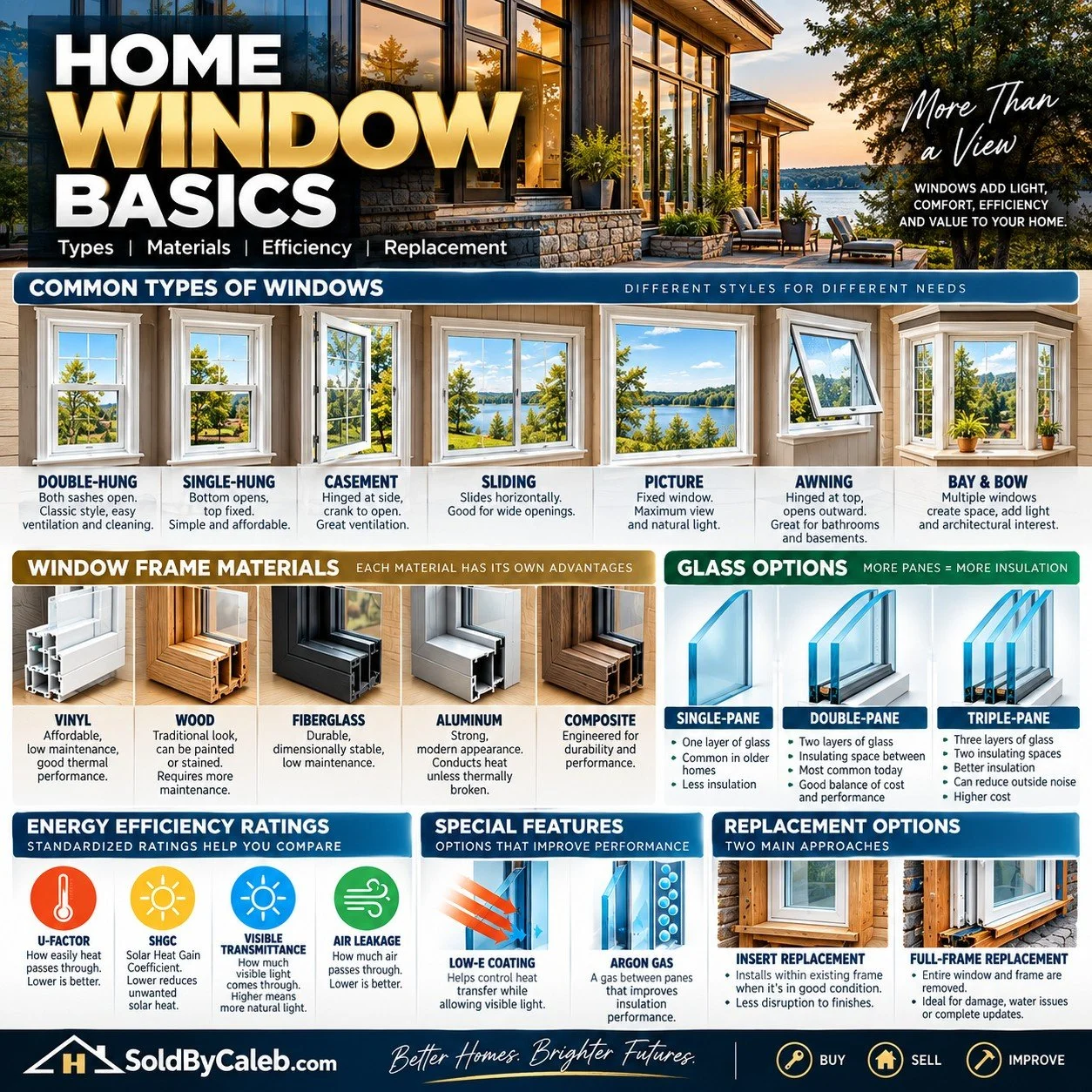
Windows do more than provide a view. They affect a home's appearance, natural light, ventilation, comfort, energy efficiency, and maintenance costs.
Whether you're buying a home, considering replacement windows, or simply wondering how your existing windows compare, understanding the basics can help you make better decisions.
And here's something worth knowing: The most expensive window isn't necessarily the best window for your home.
1. Common Types of House Windows
Windows come in several styles, and the way they open can make a big difference in everyday use.
Double-Hung Windows
Both the upper and lower sections, called sashes, move vertically.
Common in traditional and newer homes
Allow ventilation from the top or bottom
Many models tilt inward for easier cleaning
Have more moving parts than fixed windows
Single-Hung Windows
The bottom sash opens while the upper sash remains stationary.
Typically less expensive than comparable double-hung windows
Simple design
Fewer moving components
Casement Windows
These windows are hinged on one side and usually open outward using a crank.
Excellent ventilation
Can provide tight seals when closed
Convenient in areas where sliding a window would be difficult
Require outdoor clearance to open
Sliding Windows
One or more sections slide horizontally along a track.
Good for wider window openings
Simple to operate
Common in ranch and contemporary homes
Tracks require occasional cleaning
Picture Windows
Picture windows are fixed and do not open.
Provide large, unobstructed views
Allow plenty of natural light
Generally offer good air sealing
Do not provide ventilation
Awning Windows
Hinged at the top, these windows open outward from the bottom.
Often used in bathrooms and basements
Can provide ventilation during some light rain
Work well above or below fixed windows
What about bay and bow windows?
These aren't separate operating mechanisms. They're arrangements of multiple windows that project outward from the house, often creating a wider view and additional architectural interest.
2. Window Frame Materials: What's the Difference?
The material surrounding the glass affects maintenance, durability, insulation, appearance, and cost.
Vinyl Windows
Vinyl is one of the most common materials used in residential replacement windows.
Advantages:
Generally affordable
Low maintenance
Doesn't require painting
Can provide good thermal performance
Considerations:
Quality varies significantly
Color and refinishing options may be limited
Lower-quality products may be more susceptible to distortion
Wood Windows
Wood windows are commonly found in older homes and higher-end construction.
Advantages:
Traditional appearance
Can be painted or stained
Suitable for many historic architectural styles
Considerations:
Require ongoing maintenance
Can deteriorate when exposed to moisture
Often cost more than vinyl
Fiberglass Windows
Fiberglass is a durable material used in both new construction and replacement windows.
Advantages:
Dimensionally stable
Low maintenance
Good durability
Often available with relatively narrow frames
Considerations:
Typically higher upfront cost
Fewer product choices in some markets
Aluminum Windows
Aluminum provides strength and can support narrow, modern-looking frames.
Advantages:
Strong and durable
Contemporary appearance
Low maintenance
Considerations:
Conducts heat readily
Thermal breaks are important for energy performance
Composite Windows
Composite windows combine engineered materials, sometimes including wood fibers and polymers.
They can offer good durability and low maintenance, but performance depends on the specific product.
The takeaway: Frame material matters, but the overall window design, glass package, installation, and maintenance matter just as much.
3. Single-Pane, Double-Pane, and Triple-Pane Glass
One of the biggest differences between windows is the number of glass panes.
Single-Pane Windows
These have one layer of glass.
They're common in older homes but generally provide less insulation than modern insulated windows.
Some homeowners improve their performance by adding storm windows rather than replacing the entire window.
Double-Pane Windows
Double-pane windows have two layers of glass separated by a sealed space.
Better insulation than typical single-pane glass
Common in modern homes
Available with energy-efficient coatings and gas fills
Often provide a good balance of cost and performance
Triple-Pane Windows
Triple-pane windows have three layers of glass and two insulating spaces.
Can improve thermal performance
May help keep interior glass surfaces warmer in winter
Can improve sound reduction, depending on the design
Usually cost more and weigh more
Is triple-pane always better?
Not necessarily.
A high-quality double-pane window with the right glass coatings and proper installation may be a better value than a more expensive triple-pane window.
Compare actual performance ratings rather than assuming more glass automatically means a better purchase.
4. Understanding Window Energy Efficiency
Window manufacturers advertise plenty of energy-saving features, but standardized ratings make comparison easier.
The National Fenestration Rating Council provides independent performance ratings for windows.
Here are four important measurements:
U-Factor
Measures how readily heat passes through a window.
Lower numbers generally mean better insulation.
Solar Heat Gain Coefficient (SHGC)
Measures how much solar heat passes through the window.
Lower numbers reduce unwanted solar heat gain, which can be helpful in warmer climates or on sun-exposed elevations.
Visible Transmittance (VT)
Measures how much visible light passes through the window.
Higher numbers generally mean more natural light.
Air Leakage
Measures how much air passes through the window assembly under test conditions.
Lower numbers indicate less leakage.
What Is Low-E Glass?
Low-E stands for low emissivity.
It's a thin coating applied to glass to help control heat transfer while allowing visible light into the home.
Different Low-E coatings are designed for different performance goals.
What Is Argon Gas?
Some insulated windows contain argon gas between the panes.
Argon conducts heat less readily than ordinary air, helping improve the insulating performance of the glass assembly.
For a useful explanation of these features and how to compare products, visit ENERGY STAR's High Performing Windows or Storm Windows guide.
5. Replacement Windows vs. New Construction Windows
These terms can be confusing because they describe installation approaches rather than simply whether a window is new.
Insert Replacement Windows
An insert replacement window fits within an existing window frame when that frame is suitable for reuse.
Advantages:
Usually less disruption to surrounding finishes
Can be less labor intensive
Often practical when existing frames are sound
Considerations:
May slightly reduce visible glass area
Existing concealed problems may remain
Not appropriate for every opening
Full-Frame Replacement Windows
The existing window assembly is removed, allowing the new unit to be installed into the prepared opening.
This can be useful when:
The original frame is damaged
Water intrusion is suspected
The opening needs modification
The homeowner wants to address the surrounding flashing and insulation
New construction windows commonly use attachment flanges designed to integrate with the wall's water-resistive barrier.
A properly installed window is just as important as the window itself.
Even an expensive product can develop drafts or water problems if it isn't installed and flashed correctly.
6. Common Window Problems Homeowners Should Recognize
Not every window problem requires replacing the entire unit.
Fog Between the Glass Panes
If condensation appears inside the sealed space between panes, the insulated glass seal may have failed.
Some windows allow replacement of the insulated glass unit without replacing the entire frame.
Drafts Around Windows
Possible causes include:
Worn weatherstripping
Poorly adjusted or damaged sashes
Gaps around the window frame
Improper installation
Air leaks in the surrounding wall
Before buying new windows, identify where the air is actually entering.
Condensation on the Inside Surface
Moisture forming on the room-facing glass is different from condensation trapped between panes.
Interior condensation can result from indoor humidity meeting a cold glass surface.
It doesn't automatically mean the window is defective.
Windows That Stick or Won't Stay Open
Possible causes include worn balances, damaged hardware, paint buildup, or frame movement.
Some problems can be repaired relatively inexpensively.
Water Stains or Rot Around Windows
These deserve particular attention.
Water intrusion may involve damaged flashing, failed exterior details, deteriorated materials, or improper installation.
Simply applying more caulk may not correct the underlying problem.
7. When Is It Worth Replacing Windows?
There's no universal age at which every window must be replaced.
Some older windows continue functioning well for decades. Others develop problems much sooner.
Consider replacement when:
Frames are severely deteriorated
Water intrusion continues despite appropriate repairs
Windows are difficult or unsafe to operate
Multiple insulated glass seals have failed
Existing windows provide poor comfort or efficiency
Maintenance costs are becoming excessive
But before spending thousands of dollars, consider whether repairs, weatherstripping, air sealing, or storm windows could solve the problem.
ENERGY STAR also identifies storm windows as a potential lower-cost efficiency improvement, particularly for homes with existing single-pane windows.
One important consideration: New windows may improve comfort, appearance, and efficiency, but energy savings alone may not recover the entire replacement cost.
8. Should You Replace Windows Before Selling Your Home?
This is where homeowners sometimes spend more money than necessary.
Older windows don't automatically mean a home needs new windows before going on the market.
There's a difference between windows that are:
Older but functioning properly
Outdated in appearance
In need of minor repairs
Defective or allowing water intrusion
Those situations shouldn't all be treated the same.
For example, replacing every functioning window in a home shortly before selling could be a major expense without a guaranteed return.
On the other hand, addressing obvious damage, failed glass seals, or windows that won't operate properly may make sense.
I discuss this same principle in Your Home Doesn't Have to Be Updated to Show Well.
The goal isn't necessarily to make everything new. It's to understand which improvements will actually help the property.
9. What Should Buyers Look for When Inspecting Windows?
When touring a home, pay attention to more than the appearance of the glass.
Look for:
Condensation between panes
Soft or deteriorated wood
Water stains around the trim
Cracked or damaged glass
Windows that don't open or close properly
Broken locks or damaged hardware
Noticeable drafts
Signs of poor installation
Ask the seller when the windows were installed and whether any warranties or installation records are available.
For bedroom windows, emergency escape and rescue requirements may also be important, depending on the room and applicable building codes.
A home inspector can evaluate visible window conditions, although concealed installation problems may require additional investigation.
Windows are just one of several important components to consider when purchasing a property. For a broader overview, read my 9 Things to Look For When Buying a Home.
10. What About Window Warranties?
Window warranties can vary considerably.
Before purchasing, ask:
How long is the glass seal covered?
Are frames and hardware covered separately?
Does the warranty include labor?
Is the warranty transferable to a future homeowner?
Are there exclusions for installation or maintenance?
Who handles warranty service if the installer goes out of business?
A lifetime warranty sounds appealing, but the details determine what it actually covers.