
Buying Vacant Land to Build a Home: What You Need to Know Before Purchasing
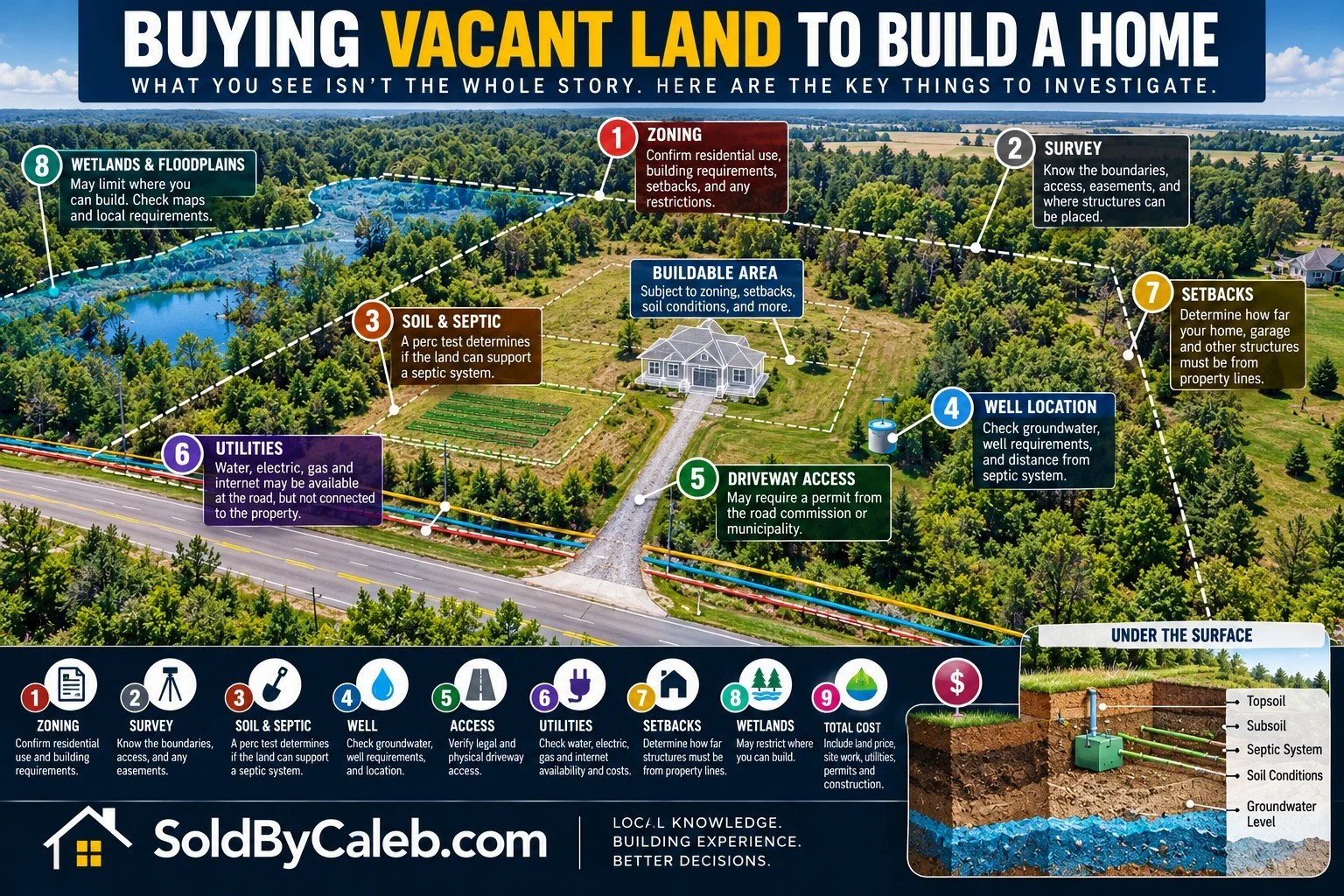
There's something exciting about finding the perfect piece of land and imagining the home you could build on it.
Maybe it's five acres surrounded by trees, a quiet country lot, or a property with enough room for a house, pole barn, and plenty of outdoor space.
But buying vacant land is very different from buying an existing home.
Just because a property is advertised as buildable doesn't necessarily mean you can build the home you want, where you want, or within your budget.
Before purchasing vacant land in Michigan, here are ten important things to investigate.
1. Zoning: Can You Build What You Want?
One of your first calls should be to the city or township where the property is located.
Zoning determines how land can be used and what types of structures may be permitted.
Questions worth asking include:
Is the property zoned for residential use?
Is a single-family home permitted?
What are the minimum lot size and road frontage requirements?
Are there minimum or maximum building dimensions?
Can you build a pole barn, detached garage, or accessory dwelling?
Are there restrictions on livestock, recreational vehicles, or other intended uses?
Is the parcel legally established, or is a land division still pending?
If the seller is in the process of splitting a larger parcel, find out whether the split has actually been approved.
A proposed survey or drawing showing a future lot does not necessarily mean that lot has received the required approvals.
Important: A neighboring property having a house does not automatically establish that your parcel can be developed the same way.
2. Surveys, Boundaries, and Easements
A land survey helps establish exactly what you're purchasing.
It may identify property boundaries, improvements, easements, and other conditions that affect how the land can be used.
Before purchasing, investigate:
Are the property corners established?
Does the legal description match the parcel being sold?
Is there adequate road frontage?
Are there utility, drainage, or access easements?
Does another property have rights to use part of the land?
Where could a house, driveway, garage, and other improvements be placed?
An easement might allow a utility company access across part of the property or give a neighboring owner the right to use a driveway.
These restrictions can affect where you build.
If the parcel is being created through a new land division, confirm what additional surveying, approvals, and recording may be necessary.
3. Soil Conditions and Septic Approval
This is one of the most important considerations when buying property without municipal sewer service.
A home needs an approved method of wastewater disposal.
For many rural Michigan properties, that means installing a private septic system.
The local health department generally evaluates whether the site is suitable for an onsite wastewater system.
People commonly refer to this process as a perc test, although the actual evaluation may involve soil borings, soil characteristics, groundwater conditions, and other site-specific requirements.
Before purchasing, ask:
Has a soil evaluation been completed?
Are the results available?
Was the proposed septic location approved?
Is there enough suitable space for the system and any required replacement area?
Would a conventional system work, or would an engineered alternative be necessary?
Are additional permits or evaluations required?
An engineered septic system may be possible when a conventional system isn't suitable, but it can be considerably more expensive.
A failed conventional soil evaluation doesn't automatically make the property unusable. However, it could significantly change your building plans or budget.
For more background on these systems, read Buying a Home With a Septic System: What Buyers Should Know.
That article focuses on existing systems, while vacant land requires evaluating whether a new system can be approved and installed.
4. Water Supply and Well Requirements
If municipal water isn't available, you'll likely need a private well.
Don't assume that because neighboring properties have wells, drilling one on your parcel will be straightforward or inexpensive.
Investigate:
Is municipal water available?
If not, is a private well permitted?
What are the local well permit requirements?
Are there known groundwater quantity or quality concerns?
Where could the well be installed?
How far must it be from the septic system and other potential contamination sources?
What are the likely drilling and installation costs?
The proposed well location can influence where you place the home and septic system.
The local health department and a qualified well contractor can help evaluate these considerations.
5. Utilities: At the Road Doesn't Mean at the House
A vacant land listing might advertise electricity and natural gas at the road.
That's useful information, but it doesn't tell you what installation will cost.
Depending on the parcel, you may need to pay for utility extensions, poles, underground service, transformers, meters, or other equipment.
Investigate the availability and cost of:
Electricity
Natural gas
Municipal water
Public sewer
Internet
Telephone or other communications services
A house located 500 feet from the road could involve very different utility expenses than one located 75 feet away.
Contact the actual service providers and ask about connection requirements, capacity, extension costs, and estimated installation timelines.
A property with utilities nearby isn't necessarily a property with affordable utility connections.
6. Wetlands, Floodplains, and Drainage
Some of the most beautiful vacant parcels contain wetlands, wooded lowlands, ponds, or natural drainage areas.
These features may be attractive, but they can also restrict development.
Before purchasing, investigate:
Are there regulated wetlands on the property?
Is any portion within a floodplain?
Are there drainage easements or established watercourses?
Does water collect in certain areas after heavy rainfall?
Would filling, grading, or installing a driveway require special approvals?
Is there sufficient suitable land outside restricted areas for the proposed improvements?
Michigan's Department of Environment, Great Lakes, and Energy provides a helpful Wetlands Map Viewer.
This is a useful starting point, but the map only identifies potential wetland locations. It does not establish exact boundaries or determine whether a particular project requires a permit.
A qualified consultant or appropriate agency evaluation may be necessary.
You can also review flood hazards through the FEMA Flood Map Service Center.
Remember: Land doesn't have to appear wet during your visit to contain wetlands or seasonal drainage issues.
7. Setbacks and the Actual Buildable Area
Owning five acres doesn't necessarily mean you can build anywhere within those five acres.
Local zoning regulations may establish minimum distances between buildings and property lines.
These are called setbacks.
Other limitations might involve wetlands, easements, septic locations, wells, road rights of way, and other site conditions.
Together, these restrictions determine the practical building area.
For example, a parcel could have plenty of total acreage but only one relatively small location suitable for the house.
Before purchasing, consider the entire proposed layout:
House and foundation
Garage or pole barn
Driveway
Septic system and replacement area
Well
Drainage improvements
Outdoor living areas
Future additions
If you have a particular floor plan or building footprint in mind, discuss it with the zoning department and a builder early.
8. Road Access and Driveway Requirements
A parcel bordering a public road doesn't automatically guarantee approval for a driveway in your preferred location.
Driveway permits may be required from the local municipality, county road commission, or Michigan Department of Transportation, depending on who controls the road.
Potential considerations include:
Legal access to the property
Road frontage
Sight distance and driveway placement
Culvert requirements
Drainage
Driveway width and slope
Emergency vehicle access
Private road maintenance agreements
If the property uses a private road or shared driveway, investigate who maintains it and how those expenses are divided.
A long driveway can also add substantial costs for clearing, excavation, gravel, pavement, culverts, and snow removal.
Michigan buyers considering property along a state highway can review MDOT's driveway and right of way permit information.
9. The True Cost of Building on Vacant Land
One of the biggest mistakes buyers can make is comparing vacant land prices without considering development costs.
Imagine two properties.
Property A: $75,000
Property B: $110,000
Property A appears to be the better deal.
But what if Property A requires extensive clearing, a long driveway, utility extensions, difficult excavation, and an expensive septic system?
Meanwhile, Property B has easier access, nearby utilities, favorable soil conditions, and a relatively level building area.
The less expensive property could ultimately cost significantly more to develop.
Your total project budget may include:
Land purchase price
Closing costs and financing
Surveying
Soil evaluations
Engineering and site plans
Permits and fees
Tree clearing and stump removal
Grading and excavation
Driveway installation
Well and septic installation
Utility connections
Foundation construction
Home construction
Landscaping and drainage
Unexpected expenses and contingency funds
Before deciding that a parcel is affordable, consider the combined cost of land, site development, and construction.
10. Financing and Purchase Agreement Protections
Financing vacant land is not always the same as financing an existing home.
Depending on your plans, you might purchase the land with cash, obtain a land loan, or use a construction financing program.
Construction lenders may require building plans, contractor information, budgets, appraisals, and other documentation before approving financing.
It's worth speaking with a lender experienced in vacant land and new construction early in the process.
Equally important is the purchase agreement.
If you're buying land specifically to build a home, you may need time to investigate whether the property can actually accommodate your plans.
Depending on the circumstances, appropriate contingencies could address:
Zoning and intended use
Land division approval
Survey and title review
Soil and septic suitability
Legal and physical access
Utility availability
Wetland or environmental concerns
Financing
The specific wording and deadlines matter.
A general inspection contingency may not adequately address every development issue, and some evaluations or approvals can take longer than expected.
Don't let your due diligence period expire before you've answered the questions that determine whether the land will work for you.
Who Should You Talk to Before Buying Vacant Land?
Depending on the property, you may need assistance from several professionals.
Real estate agent: Helps evaluate the purchase, coordinate due diligence, and negotiate appropriate terms.
Municipal zoning department: Explains permitted uses, setbacks, and applicable development requirements.
County or local health department: Provides information about septic and well approvals.
Land surveyor: Establishes boundaries and identifies relevant site features.
Builder: Helps evaluate the proposed home location, construction requirements, and potential site costs.
Utility providers: Explain connection availability and estimated expenses.
Engineer or environmental consultant: Evaluates specialized site conditions when necessary.
Construction lender: Explains financing requirements for the land and proposed home.
Getting the right people involved early can help prevent expensive surprises later.
This article provides general educational information. Zoning, permits, environmental requirements, construction feasibility, and financing vary by property and jurisdiction. Verify requirements with the appropriate authorities and qualified professionals before purchasing.
Before You Buy Vacant Land
15 steps to help you identify deal breakers before spending money on unnecessary testing.
Establish appropriate purchase agreement contingencies and deadlines before becoming contractually committed. Some investigations may overlap, and paid testing may require the seller's permission.